

AI is Getting Smarter.
TEAMS STILL RUN
ON TRUST.
Today’s loneliness rarely looks like isolation. More often, it looks like a woman with a full calendar, strong relationships, and a life that appears beautifully held together. Shasta Nelson helps women build the friendships that sustain them—not just socially, but emotionally and personally.
FRIENDSHIP EXPERT
TRUSTED BY LEADERS AND ORGANIZATIONS WORLDWIDE


Shasta has delivered keynote presentations for technology and innovation teams including Walmart engineering groups, Gilead Sciences, and digital health organizations—helping distributed teams strengthen collaboration, trust, and performance.
Technology is Evolving Fast.
Human Connection isn't Automatic Anymore.
Today, work looks different. Teams are hybrid or remote, and communication happens mostly through screens. Research shows this shift leads to fewer spontaneous interactions and weaker relationships, both essential for innovation.
Connection is no longer built into the system. It must be built intentionally.
Relationships are the operating system of a team. When they are strong, collaboration flows and work accelerates. When they are weak, communication becomes cautious and work turns transactional.
Innovation depends on trust. The best ideas emerge when people feel safe to share early thoughts, challenge assumptions, and speak honestly. Research shows that psychological safety, not intelligence or experience, is the key to high-performing teams.
And psychological safety grows out of relationships. Without that foundation, even the most talented teams experience friction, not because the ideas are not there, but because trust is.
"Her sessions weren’t just informative, they were connective."
"What impressed me most was her gift for creating a space where our associates felt truly seen and heard. Her sessions weren’t just informative—they were connective. Shasta models the very principles she teaches: psychological safety, empathy, and adaptability. Shasta’s work doesn’t just inspire; it drives real impact. She equips people with tools to build stronger relationships and helps shape the inclusive, safe, and trust-based culture we’re striving for."
SAVANNAH HALL
Manager II, Program Management Corporate Functions and Technology Early Careers, Walmart

A Keynote That Shows Teams How Relationships Actually Work
Most teams assume connection will happen naturally, especially when talented people are working toward shared goals.
But in hybrid and fast-moving environments, relationships rarely strengthen on their own.
In her keynote, Shasta Nelson introduces a simple framework for healthy relationships: positivity, consistency, and vulnerability.
Once teams understand these dynamics, something shifts. They begin to see why some collaborations build trust quickly while others slowly weaken. More importantly, they gain clarity on what to do differently.
Instead of hoping connection emerges organically, leaders and teams learn how everyday interactions, including how they communicate, follow up, and support one another, either strengthen or weaken the relational foundation of the team.
By the end, audiences know which relational levers to pull to improve communication, increase psychological safety, and create conditions where ideas move faster and innovation thrives.
Because the goal is not more meetings. It is stronger relationships inside the work that is already happening.
What this Means for Your Organization or Conference
When relationships strengthen inside technology teams, organizations begin to see:
Distributed clearer communication across distributed teams
Faster collaboration and problem-solving
Greater psychological safety to speak up and share ideas
Stronger engagement in hybrid environments
More innovative thinking and better decision-making
Because the teams that innovate best aren’t just the smartest teams.
They’re the teams that trust each other enough to speak honestly, challenge ideas, and solve problems together.
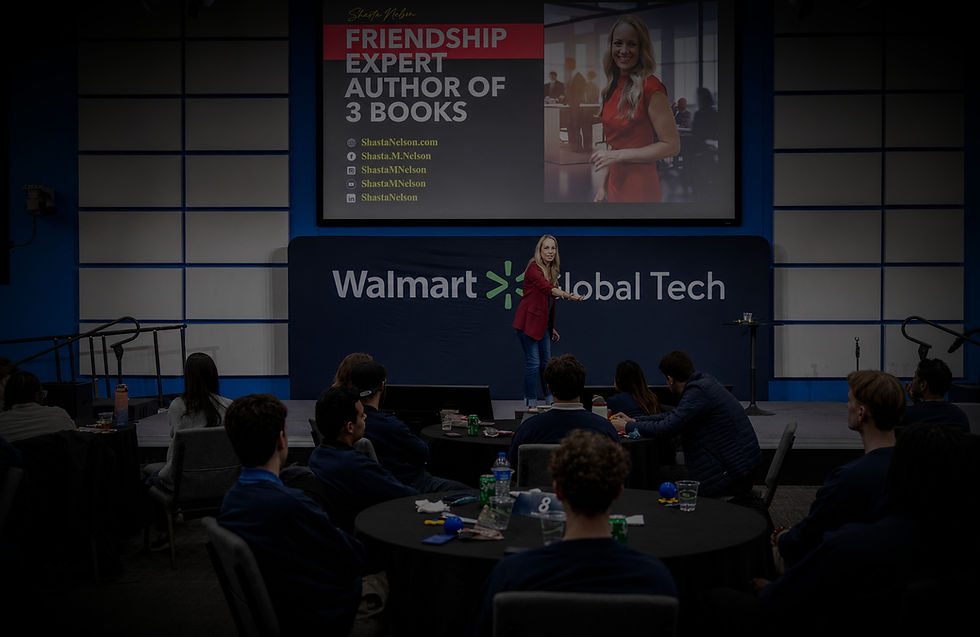
Why Technology Organizations
CHOOSE SHASTA
For more than fifteen years, Shasta Nelson has studied the science of human connection and translated that research into clear, practical frameworks teams can apply immediately.
Instead of asking teams to “just communicate better,” she helps them see the patterns behind trust—what strengthens it, what weakens it, and how everyday interactions shape team culture over time. That clarity is especially powerful in technology organizations where people are already wired to think in terms of systems, patterns, and intentional design.
As Chief Friendship Officer for the U.S. Chamber of Connection and author of three books on relationships, Shasta brings both credible research and practical insight to a topic that is often treated as accidental. And in a world increasingly shaped by AI, that human advantage has never mattered more.
"She left the team with incredible insights & thinking tools that are just so valuable for a mindset change."
Shasta is a powerhouse speaker & educator! Shasta hosted an incredible virtual session on the business of belonging & relationships for my Marketing team at Google. She left the team with incredible insights & thinking tools that are just so valuable for a mindset change. Our event with Shasta felt like a warm but productive hug with a focus on being intentional about the experiences people are creating for each other.

SUPRIYA GUJRAL
Senior Director, Global Partner Marketing at Google


If your teams are navigating hybrid work, AI-driven change, and the growing need for stronger collaboration, Shasta Nelson helps them build the relationships that make innovation possible.
.png)